Concrete Slab Cost Calculator
Estimate exact cubic yardage, safety buffer allowances, and ready-mix material expenses before placing an order with your local batch plant.
Dimensional Parameters
Enter finished form dimensions and plant pricing.
Field Spec Summary
Includes 10% safety allowance rounded up in 0.25 yd³ increments, then converted to the selected units. Verify your supplier’s batch increments.
Ready-mix prices and professional contractor installation costs vary by location and regional batch plant rates. Call your supplier to verify minimum dispatch loads.
Supplier Ordering Rule
Ask your supplier about minimum billed quantities, batch increments and short-load fees. This calculator uses 0.25 yd³ increments in both unit modes; supplier ordering rules may differ.
Measure interior chalk lines
Always measure between the inside faces of your 2×4 or 2×6 form boards to avoid adding framing thickness to your calculation.
Factor ground irregularities
An uncompacted or uneven gravel subgrade can easily consume an extra half-inch of concrete depth across large slab surface areas.
Never run short on a pour
Running out of concrete midway through finishing causes weak cold joints and emergency delivery charges. The 10% buffer protects your pour.
Worked slab example
10 × 10 ft × 4 in (3.048 × 3.048 m × 101.6 mm) gives 1.234568 yd³ net. Apply 10% waste, then round up to 1.50 yd³ (1.146832 m³). At $150/yd³ plus $100 delivery, the estimate is $325 in either unit mode.
Includes quoted concrete and delivery only. Tax, labor, reinforcement and unentered supplier fees are excluded. USD remains the currency; switching units converts dimensions, volume and unit price for the same pour.
How slab estimation works
Three practical steps to calculate exact yardage and order ready-mix concrete without costly shortages or overage fees.
Choose U.S. for feet and inches, or Metric for meters and millimeters. Enter inside form dimensions, measured thickness, waste, quoted unit price and delivery.
Tip: Measure the depth at multiple form stakes to account for uneven grade.
Review net volume, your editable waste allowance, rounded order quantity and concrete-plus-delivery cost. The order rounds in physical 0.25 yd³ increments before unit conversion.
Real-time updates let you adjust slab thickness or waste allowances instantly.
Call your local ready-mix dispatch or building supply yard with your verified cubic yardage, project slump specs, and site access details.
Confirm the supplier’s minimum billed quantity, batch increments and any short-load charges; none is assumed beyond the displayed rounding rule.
Ready to calculate? Get your yardage and cost figures instantly on our free estimator.
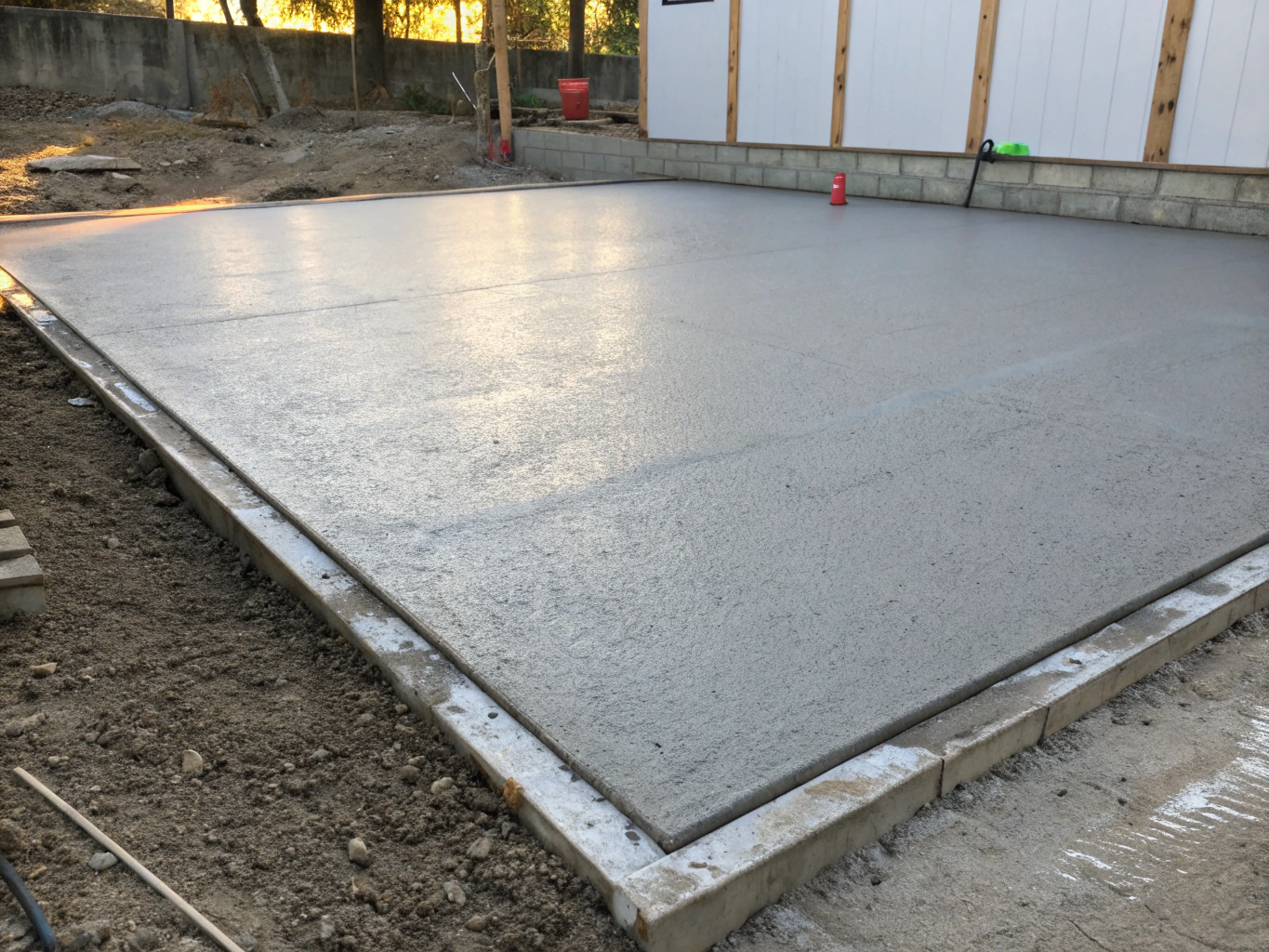
Why exact concrete volume matters
Under-ordering concrete causes cold joints, visible structural seams, and costly emergency short-load delivery delays. Over-ordering leaves you paying for excess concrete that cannot be returned to the truck. Calculating exact volume and adding a controlled waste factor before you place the dispatch call protects both your slab and your budget.
Cold joints & structural seams
Running out of concrete mid-pour creates a cold joint where old and new mix meet, permanently weakening the slab.
Emergency short-load delays
Ordering a second truck on the fly costs hours of waiting while your first pour sets, plus expensive short-load dispatch fees.
Unreturnable excess material
Ready-mix cannot be returned to the batch plant. Any leftover cubic yards you ordered are yours to pay for and discard.
Always round slab thickness up to account for uneven subgrade and form deflection.
A 4-inch planned slab poured on uncompacted gravel often settles at 4.25 to 4.5 inches across low spots.
Job-site rules for ordering ready-mix concrete
Four practical checks to make before calling your local batch plant so you avoid short-load fees, cold joints, and site delays.
This calculator rounds after waste in 0.25 yd³ increments, including metric mode. Your supplier may use different increments; confirm the final billed quantity before ordering.
Ask your dispatcher about minimum billed volume and quoted short-load fees. These vary by supplier and are not automatically added by this slab calculator.
Confirm compressive strength ratings (typically 3,000 to 4,000 PSI for slabs) and seasonal slump requirements. Hot summer pours or freezing morning pours require adjusted set times.
A loaded concrete truck weighs up to 70,000 pounds. Check for low-hanging overhead power lines, narrow gates, soft soil shoulders, and thin residential asphalt that might crack under axle weight.
Planning estimates only
All numbers generated by Before Pour tools are volumetric estimates intended strictly for project budgeting, preliminary scheduling, and material planning. They do not constitute structural, civil engineering, or architectural specifications.
Actual yardage needs vary based on uneven excavation depths, sub-base compaction, form deflection, ground settlement, and delivery batch minimums. Always consult a licensed general contractor, registered structural engineer, or your local ready-mix dispatch specialist before ordering concrete for structural footings, stem walls, or load-bearing slabs.
Common questions before your pour
Straight answers to help you plan your pour, avoid short loads, and understand ready-mix pricing before placing your order.